Now as He sat on the Mount of Olives, the disciples came to Him privately, saying, “Tell us, when will these things be? And what will be the sign of Your coming, and of the end of the age?
And Jesus answered and said to them: Take heed that no one deceives you.
- Matthew 24:3-4 (NKJV)
I found it interesting that when Jesus answered the question pertaining His return and the end of times, He prefaced His response with a warning, before using parables as a framework for His answer. The warning was quite simple and to the point – be careful so that you are not deceived.
Deception according to the Merriam-Webster dictionary, is the act of causing someone to accept as true/valid, what is false/invalid. The Cambridge dictionary further explains that this action is often to the deceiver’s advantage. If you search the word on Google, the next thing to pop up after the definition is a breakdown of its key elements, namely: intentionality, methods used, the motivation behind the action and what it may look like.
Jesus answers the question in great detail, using parables to help us understand concepts that our minds might otherwise find complex. He could’ve just went ahead to share these parables and then give a warning, or maybe not even mention the possibility of being led astray. Why then did He deem it necessary to warn the disciples about staying on guard so that they are not deceived? Well, my guess is that He probably knew about the propensity of the human nature to get stuck up on what we see at face-value, accept it as is and for what it is, and run with it without ever pausing to wisely interrogate the matter.
Let’s take a brief look at the key elements of deception as suggested by the internet before delving a little deeper into this post’s title.
Intentionality
The person who deceives knows exactly what they are doing. It’s not an accident or mistake. It is deliberate and the thing about deliberate actions is that they are not haphazardly done, planning is involved. The execution of the action relies on detailed planning to make it successful. No one can ever claim unintentionally deceiving another.
Methods of Deception
For anyone who bakes or who has been involved in any form of research, you will know that a method is an extremely particular and systemic way of doing something. If you miss a step, the results will not be what was desired or planned from the beginning. When I was in high school, one of the concepts that my Mom, a science teacher, taught me when it came to doing experiments was having a method to follow before carrying out the experiment. When I was doing my assignments, bringing a completed project to her before showing her a page with a detailed method was never an option. Her question was always, “How are you going to be able to do this again and have the exact outcome if you don’t know the details of what you did? Better yet, how can someone else replicate this and obtain the same results?”
My point? Deception has a specific desired outcome. The methods are the steps followed to get there. Be it lies, exaggeration, omission or façades. And quite frankly, each of these tactics require a series of steps.
Motivation
Deception always benefits the deceiver, to the detriment of the one on the receiving end.
Forms of Deception
This is apparently a spectrum that ranges from harmless to serious or life-threatening situations. Honestly, I am skeptical about deception ever being harmless. The internet suggests otherwise, and reckons that entertainment can be a form of deception that we can enjoy without sustaining any harm. True. To some extent, and maybe not in the short-term. Hence the warning to stay on guard against being misled.
The return of our Lord and Saviour Jesus Christ, and the end of times requires us to take heed against deception.
Hey leader!
It’s been a minute (more like a few hundreds of thousands of minutes) since I shared anything on this platform. Welcome back!
“A distracted bride is an easily deceivable bride…” These are the words I heard yesterday as I was getting ready to go to work. Over the past few weeks, I have been journeying with the Lord on something that was meant to be the first post I upload as I begin to write again. Although different, the topics are related so that will be my next post to complete and wrap up this one…
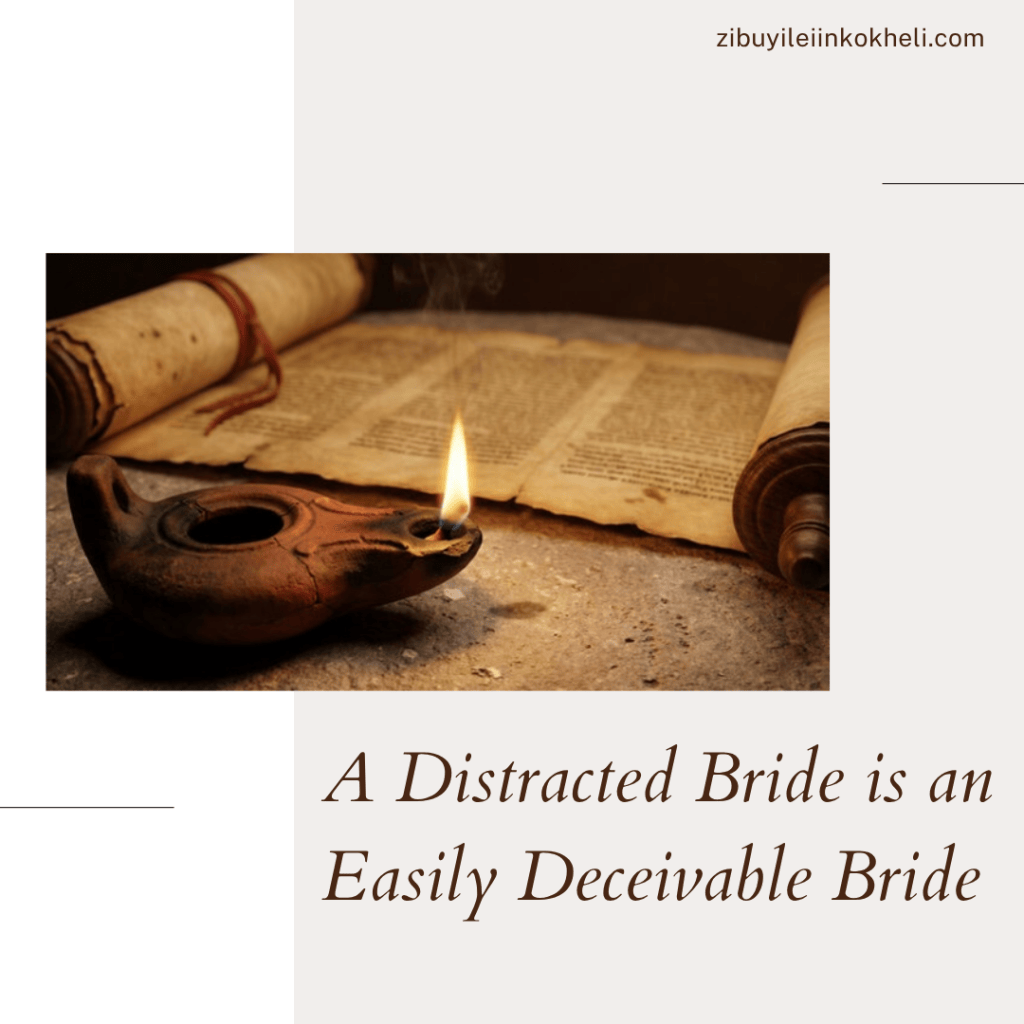
THEN THE kingdom of heaven shall be likened to ten virgins who took their lamps and went to meet the bridegroom. Five of them were foolish (thoughtless, without forethought) and five were wise (sensible, intelligent, and prudent). For when the foolish took their lamps, they did not take any [extra] oil with them; But the wise took flasks of oil along with them [also] with their lamps.
While the bridegroom lingered and was slow in coming, they all began nodding their heads, and they fell asleep. But at midnight there was a shout, Behold, the bridegroom! Go out to meet him! Then all those virgins got up and put their own lamps in order. And the foolish said to the wise, Give us some of your oil, for our lamps are going out. But the wise replied, There will not be enough for us and for you; go instead to the dealers and buy for yourselves. But while they were going away to buy, the bridegroom came, and those who were prepared went in with him to the marriage feast; and the door was shut.
Later the other virgins also came and said, Lord, Lord, open [the door] to us! But He replied, I solemnly declare to you, I do not know you [I am not acquainted with you].
Watch therefore [give strict attention and be cautious and active], for you know neither the day nor the hour when the Son of Man will come.
Matthew 25:1-13 (AMPC)
The Bible uses marriage as a metaphor of the relationship between Jesus Christ (the Bridegroom) and the Christian Church as a collective/Christians as individuals (the Bride). We are the bride.
Jesus, in Matthew 24-25, answers the question that plagued the disciples’ minds. How would they know that Jesus would be returning soon and that the times were drawing to an end? The reply began with a warning, followed by an explicit description of what was to come, then parables.
The parable of the fig tree. A parable about life happening ‘as usual’ on the hour He returns. A parable about the faithful and evil servants. The parable of the wise and foolish virgins. The parable of the talents. The judgement of the nations. Jesus gave a thorough answer to help us escape deception.
The Holy Spirit was kind enough to refer me to the parable of the wise and foolish virgins when the thought i.e. the title of this post came to mind. Hence the reference to the bride. I have read the story multiple times before, listened to many sermons and still, yesterday I remained with a question I had never asked myself before.
There were ten virgins, all of them had the same brief about meeting the bridegroom so that they could prepare themselves for the wedding, which is why they all had lamps. However, Jesus details that five of them were wise and the other five were foolish. Foolish? How? Why?
I suppose that the brief did not have a disclaimer about how weddings could be delayed and run behind schedule because it was implied. In this post, I will not dig much into the history and theology of why this wedding was delayed but I do encourage you to read up on marriage and weddings in the Old Testament – how after the bride price was paid and the families agreed on the marriage, the bride would go back to her parents’ house for a long time while the bridegroom went to prepare a place for her. Only the groom’s father knew when the waiting period would end. Sounds a lot like our covenant relationship with Jesus and His return, doesn’t it?
Anyways, back to the foolish virgins. I propose that Jesus called them foolish because they probably grew up knowing the wedding traditions of that time and culture. They had probably been a part of wedding processions prior and perhaps a lot of those wedding celebrations did not start at the time that everyone expected because again, only the groom’s father could decide when the right time was. Perhaps it was part of the preparations to have an extra jar of oil when one was going to meet with the groom. Either way, onlookers’ experience should’ve made them wiser, propelled them to think and help them prepare – the wedding might be delayed.
You don’t need a lamp to meet someone during the day, do you? This wedding happened at midnight. So I assume that it was common for the procession to start any time before sunrise. Which is why lamps were needed. Jesus was in fact correct in calling them foolish! Surely they were familiar with their lamps. They knew what their capacity for oil was and how long that amount could burn for before needing a refill.
Growing up, the first time I heard this parable I felt that Jesus was harsh with the term He used for these young women. I felt like foolish was pushing it, an exaggeration of their true nature. Now that I am older, I know better and I have gained an understanding.
The five foolish virgins had the knowledge yet they did not use it. That’s foolishness. However, may I also suggest that they were distracted. The Bible does not state this, it is just me pondering on the matter. Is it possible that the five virgins, despite having foreknowledge about the wedding procession and the potential for delays, brought their lamps without extra oil because they were distracted by other things?
Is it likely that in the busyness of them preparing for this great celebration, they got caught up in things that would later cost them meeting their groom and entrance to the wedding? When the group of ten was heading out to wait for the groom, did the five foolish virgins not stop to ask themselves why the other five were carrying extra jars of oil and they weren’t? Did they ask themselves the question and for a split second consider going back to get extra oil but didn’t? If they did, who convinced them otherwise or affirmed their decision against obtaining the extra, told them that it was ok, that they would fare just fine without the extra oil? If they were deceived, was it external or did they fall onto their own swords? Were they too distracted to a point of falling for the deception, even in light of what should’ve been obvious?
I have questions. Too many questions.
Dear leader, as you live and do life, I pray that you stay on guard so that when your story is told, Jesus returns for His bride, and time is folded into eternity; I pray that amongst the words used to describe you, foolish isn’t one of them. I pray that distraction doesn’t become your downfall.
On the next post, we will have a look at what deception in our day and age may look like because reality is, a distracted bride is an easily deceivable bride.


Leave a Reply